AcWing 18. 重建二叉树
题目
输入一棵二叉树前序遍历和中序遍历的结果,请重建该二叉树。
注意:
- 二叉树中每个节点的值都互不相同;
- 输入的前序遍历和中序遍历一定合法;
数据范围
树中节点数量范围 。
样例
给定:
前序遍历是:[3, 9, 20, 15, 7]
中序遍历是:[9, 3, 15, 20, 7]

返回:[3, 9, 20, null, null, 15, 7, null, null, null, null]
返回的二叉树如下所示:
    3
   / \
  9  20
    /  \
   15   7
思路
算法
(递归)
递归建立整棵二叉树:先递归创建左右子树,然后创建根节点,并让指针指向两棵子树。
前序遍历性质: 节点按照[ 根节点 | 左子树 | 右子树 ]排序。
中序遍历性质: 节点按照[ 左子树 | 根节点 | 右子树 ]排序。
以题目示例为例:
前序遍历划分[ 3 | 9 | 20 15 7 ]
中序遍历划分[ 9 | 3 | 15 20 7 ]
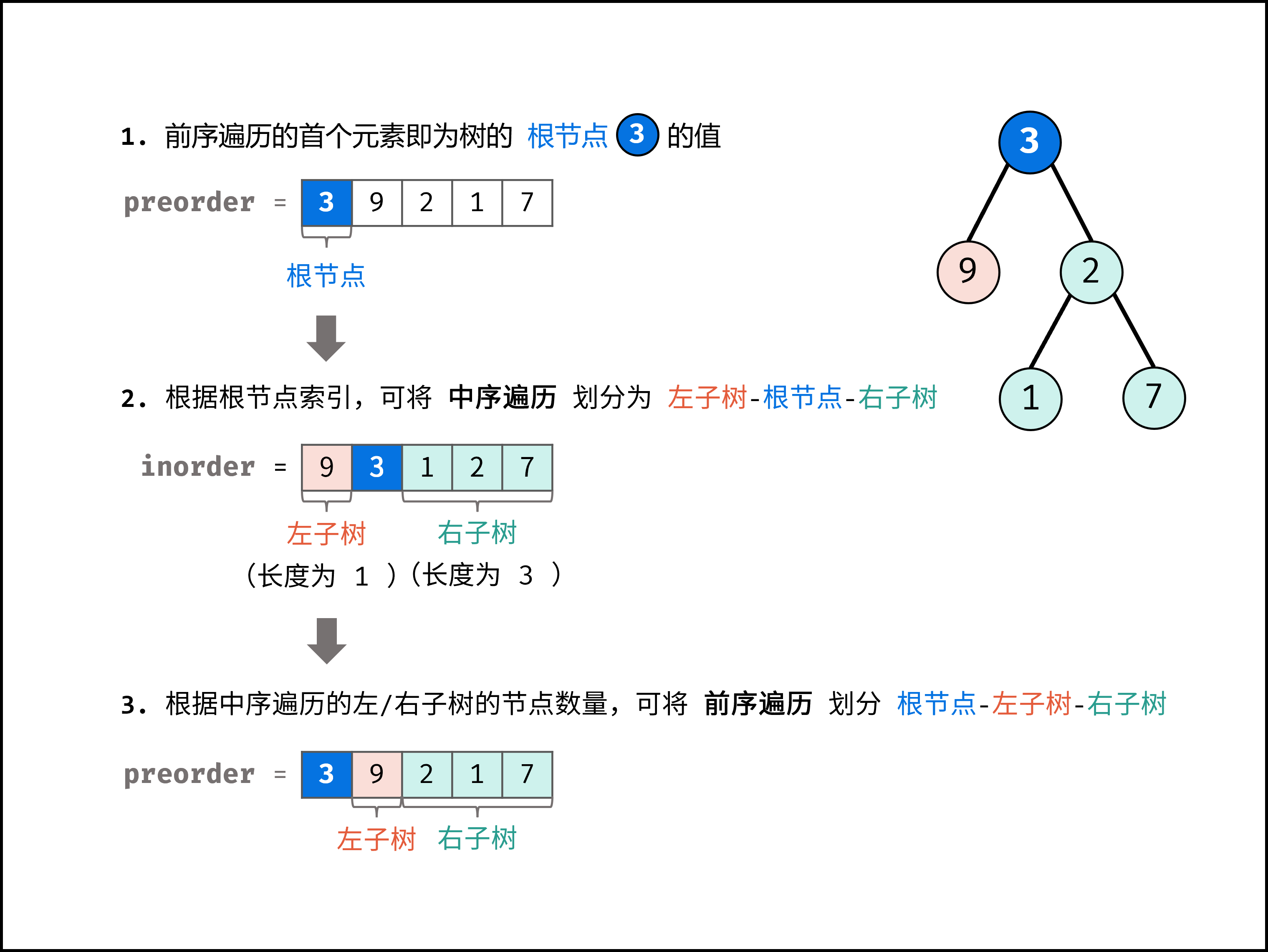
具体步骤如下:
- 先利用
前序遍历找根节点:前序遍历的第一个数,就是根节点的值; - 在
中序遍历中找到根节点的位置 ,则 左边是左子树的中序遍历,右边是右子树的中序遍历; - 假设左子树的中序遍历的长度是 ,则在前序遍历中,根节点后面的 个数,是左子树的前序遍历,剩下的数是右子树的前序遍历;
- 有了左右子树的前序遍历和中序遍历,我们可以先递归创建出左右子树,然后再创建根节点;
时间复杂度分析
我们在初始化时,用哈希表(unordered_map<int,int>)记录每个值在中序遍历中的位置,这样我们在递归到每个节点时,在中序遍历中查找根节点位置的操作,只需要 的时间。此时,创建每个节点需要的时间是 ,所以总时间复杂度是 。
注意:如果是
笔试的话,因为不可以使用STL的哈希函数,我们可以将哈希表改为线性查找,创建每个节点需要的时间从 变为 。
// 原哈希表写法 上机题用这个即可
int k = pos[root->val];

// 笔试写法 写循环即可
// 优化方法:开放寻址法、拉链法,在这里没有实现
int k = -1;
for (int i = x; i <= y; i++ )
    if (inorder[i] == root->val)
        k = i;
题解
/**
 * Definition for a binary tree node.
 * struct TreeNode {
 *     int val;
 *     TreeNode *left;
 *     TreeNode *right;
 *     TreeNode(int x) : val(x), left(NULL), right(NULL) {}
 * };
 */
class Solution {
public:
    unordered_map<int, int> pos;
    vector<int> preorder, inorder;

    TreeNode* build(int a, int b, int x, int y) {
        if (a > b) return NULL;
        auto root = new TreeNode(preorder[a]);
        int k = pos[root->val];
        root->left = build(a + 1, a + 1 + k - 1 - x, x, k - 1);
        root->right = build(a + 1 + k - 1 - x + 1, b, k + 1, y);
        return root;
    }

    TreeNode* buildTree(vector<int>& _preorder, vector<int>& _inorder) {
        preorder = _preorder, inorder = _inorder;
        int n = inorder.size();
        for (int i = 0; i < n; i ++ ) pos[inorder[i]] = i;
        return build(0, n - 1, 0, n - 1);
    }
};
参考链接
https://leetcode.cn/leetbook/read/illustration-of-algorithm/99ljye/